
You have probably felt it before. That moment when everything burns down and you wonder whether you will ever rise again. The phoenix speaks directly to that feeling. It speaks to the part of you that has been broken, tested, and pushed to its absolute edge.
The phoenix spiritual meaning is not just a poetic concept. It is one of the oldest, most universally recognized symbols in human civilization. Cultures separated by thousands of miles and centuries of history all arrived at the same myth: a magnificent bird that burns itself to ash and is reborn from those very ashes. No other symbol captures transformation, resilience, and divine renewal quite like the phoenix.
Whether you encountered a phoenix in a dream, feel drawn to its image, or are walking through a painful season of personal change, this symbol holds a message meant specifically for you. The phoenix is a spiritual mirror. It reflects your own capacity to survive fire, to transform through suffering, and to emerge more powerful than before.
This post takes a comprehensive look at phoenix symbolism and spiritual meaning across ancient cultures, world religions, mythology, dreams, and personal spirituality. By the end, you will understand why this legendary firebird has endured for thousands of years as one of humanity’s most beloved and spiritually charged symbols.
Key Takeaways
- The phoenix is the ultimate symbol of rebirth, resurrection, and transformation across nearly every major culture and religion on earth.
- Its cycle of death and renewal through fire represents the soul’s journey through hardship toward spiritual elevation.
- The phoenix appears in Egyptian, Greek, Chinese, Persian, Roman, and Native American spiritual traditions, each adding unique layers of meaning.
- Dreaming of a phoenix is widely interpreted as a powerful sign of personal transformation, new beginnings, or a call to release what no longer serves you.
- The color symbolism of the phoenix, particularly its red, gold, and orange plumage, carries distinct spiritual significance related to vitality, divine light, and sacred energy.
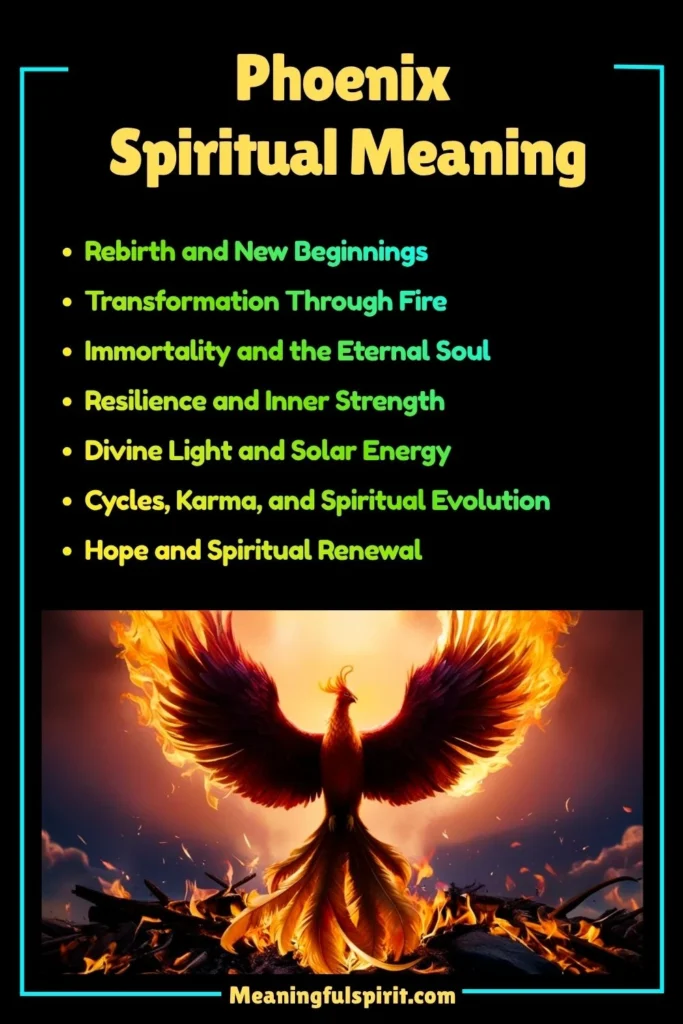
What Is the Phoenix and Why Does It Hold Such Spiritual Power?
The phoenix is a legendary, mythical bird described across dozens of ancient civilizations. In its most classic form, it is a magnificent bird of extraordinary size and beauty. It lives for hundreds or even thousands of years. When its life cycle ends, it builds a nest of aromatic herbs and spices, ignites itself in a burst of sacred flame, and then rises from the cooling ashes, completely renewed.
This image is so psychologically and spiritually potent because it mirrors something deeply human. Every person knows what it feels like to go through a period of destruction, loss, or grief. The phoenix says that destruction is not the end. It insists that the fire itself is part of the process.
From a spiritual standpoint, the phoenix holds power for several layered reasons. First, it represents the cycle of life, death, and rebirth that nearly all spiritual traditions recognize as fundamental to existence. Second, the element of fire carries enormous spiritual weight across cultures. Fire purifies. Fire transforms. Fire reveals what is essential by burning away what is not.
The phoenix also holds power because it acts willingly. It does not die by accident or violence. It chooses the flame. This is a profound spiritual statement: true transformation requires conscious surrender. You have to be willing to let the old self burn before the new self can rise.
This is exactly why the phoenix spiritual meaning has survived thousands of years of religious change, cultural shifts, and philosophical evolution. It describes something timeless about the human soul.
What Does the Phoenix Symbolize Spiritually?
At its core, the phoenix symbolizes spiritual rebirth and eternal life. But that broad statement contains many specific spiritual layers that are worth examining closely.
The phoenix symbolizes transformation through trial. It does not avoid fire. It enters fire deliberately. Spiritually, this teaches that the most profound growth comes not from comfort but from crisis. Many spiritual teachers, from Buddhist monks to Christian mystics, have pointed to the phoenix as the perfect metaphor for the dark night of the soul.
It also symbolizes hope in the face of complete ruin. When everything you have built collapses, the phoenix archetype whispers that new life is already forming in the ashes. This is not naive optimism. It is a spiritually grounded recognition that endings and beginnings are inseparable.
The phoenix further symbolizes immortality and the divine nature of the soul. In many traditions, the soul itself is described as phoenix-like: it cannot be permanently destroyed. It passes through experiences, through lifetimes even, and always re-emerges. This connects phoenix symbolism deeply to concepts of karmic cycles, reincarnation, and spiritual ascension.
Finally, the phoenix symbolizes uniqueness and sacred individuality. In most traditions, there is only ever one phoenix alive at a time. This detail carries spiritual weight. Your journey of transformation is singular. No one else’s fire looks exactly like yours.
7 Spiritual Meanings of the Phoenix
1. Rebirth and New Beginnings
The most fundamental spiritual meaning of the phoenix is rebirth. This is not simply a metaphor for recovery. It is a statement about the fundamental nature of the soul. The phoenix does not just heal from its old life. It becomes something entirely new while retaining the essence of what came before.
Spiritually, rebirth carries the understanding that you are not the same person you were before your greatest trials. Grief, illness, heartbreak, and failure all have the potential to strip away false layers of identity. What remains after the fire is the truest version of yourself. The phoenix teaches that this process is not a punishment. It is an invitation.
Many spiritual practitioners who work with phoenix symbolism point to it during periods of major life transition: divorce, career collapse, the death of a loved one, or the end of a long-held belief system. In each of these moments, the phoenix meaning offers a profoundly comforting spiritual framework. What feels like destruction is actually the sacred beginning of something greater.
New beginnings in phoenix symbolism are always more luminous than what came before. The reborn phoenix is described in ancient texts as more radiant, more powerful, and more beautiful than its former self. This is the spiritual promise embedded in the symbol: you do not just recover. You transcend.
2. Transformation Through Fire
Fire is the defining element of the phoenix, and its spiritual significance cannot be overstated. Fire in spiritual traditions worldwide represents purification, divine presence, passion, and the destruction of all that is impure. When the phoenix enters the flame, it enters a sacred purification process.
Transformation through fire means willingly entering discomfort, grief, or radical change in order to be remade. Every world religion contains this theme. In Christianity, believers speak of being refined like gold through fire. In Hinduism, the sacred fire known as Agni purifies offerings and prayers. In Buddhism, desire and ego are described as flames that ultimately destroy themselves.
The phoenix adds a crucial dimension to these teachings. It shows that transformation is not passive. The bird does not accidentally catch fire. It creates its own pyre. Spiritually, this asks a confronting question: are you willing to actively participate in your own transformation? Are you willing to let go of what no longer serves you, even if that release feels like burning?
This meaning resonates deeply with people in recovery, those undergoing intense therapy, or individuals walking through radical spiritual awakening. The fire does not feel good. However, the phoenix assures you that the fire is not destroying you. It is revealing you.
3. Immortality and the Eternal Soul
The phoenix lives for extraordinary lengths of time. Depending on the tradition, estimates range from 500 to 1,461 years per cycle. More importantly, it never truly dies. This makes the phoenix one of the most enduring symbols of immortality in human spiritual history.
From a spiritual perspective, the immortality of the phoenix points to the deathless nature of consciousness itself. Many traditions teach that the soul is eternal. Physical death is not an ending but a transition. The phoenix embodies this truth in vivid, undeniable imagery. It burns. It vanishes. It returns. Nothing essential about it is ever lost.
This spiritual meaning offers profound comfort to those who are grieving. The phoenix teaches that the people we love do not disappear. They transform. They transition. Their essence continues in forms we may not immediately recognize. Many bereaved individuals have reported finding enormous comfort in phoenix symbolism precisely because it reframes death as transformation rather than termination.
On a personal spiritual level, the immortality of the phoenix also speaks to the indestructibility of your own spirit. No matter how many times life has knocked you down, something in you persists. Something in you rises. That persistent, resilient core is exactly what the phoenix represents.
4. Resilience and Inner Strength
Resilience is not the same as toughness. Resilience is the capacity to absorb devastating impact, bend without breaking, and eventually rise again. The phoenix is the purest symbol of resilience in spiritual iconography.
The key spiritual insight here is that the phoenix does not resist the fire. It does not try to escape or avoid its destruction. It surrenders to the process entirely, and that surrender is precisely what allows the resurrection. This is a radical teaching on resilience. True inner strength is not about suppressing emotion or refusing to feel pain. It is about trusting the process of breaking open.
Many spiritual teachers, including Rumi, have pointed to this quality. His famous poem about the reed flute being cut from the reed bed captures the same energy: the instrument only sings because of its wound, not despite it. The phoenix embodies this same truth. Its power comes from having fully experienced the fire, not from having avoided it.
For anyone who has survived trauma, loss, or complete personal collapse, the phoenix carries a deeply personal message. Your resilience is not a lucky character trait. It is a spiritual capacity, built through every fire you have walked through.
5. Divine Light and Solar Energy
In many ancient traditions, the phoenix is closely associated with the sun. Its plumage of red, gold, and orange mirrors the colors of sunrise and sunset. In Egyptian mythology, the phoenix-like Bennu bird was directly linked to the sun god Ra. In Greek and Roman traditions, the phoenix was described as sacred to the sun.
This solar connection gives the phoenix a powerful spiritual meaning related to divine light, clarity, and illumination. The sun rises every day without fail. No matter how dark the night, the light returns. The phoenix carries this same promise: after every period of darkness and destruction, light will return.
Spiritually, light symbolizes consciousness, awakening, and divine awareness. When the phoenix rises, it does not just rise physically. It rises in light. This suggests that true spiritual rebirth is always accompanied by a deepening of awareness and clarity. You do not just survive your fire. You come out seeing more clearly.
This solar energy also connects the phoenix to themes of vitality and life force. The sun is the source of all biological life on earth. The phoenix, as a solar symbol, therefore represents the inexhaustible life force at the core of all existence. No matter how depleted you feel, that life force is always present, always ready to reignite.
6. Cycles, Karma, and Spiritual Evolution
The phoenix does not live a straight line. It moves in cycles. It lives, it burns, it is reborn, and eventually it will burn again. This cyclical nature places the phoenix squarely within spiritual frameworks that emphasize karma, reincarnation, and the soul’s evolutionary journey across multiple lifetimes.
In Hindu and Buddhist cosmologies, the soul moves through countless cycles of birth, death, and rebirth. Each cycle offers new lessons, new opportunities for purification, and deeper access to spiritual truth. The phoenix is a vivid embodiment of this process. Each cycle does not simply repeat the last. Each cycle elevates the soul to a higher level of being.
This meaning invites reflection on your own life cycles. Consider the patterns you have moved through: the relationships that ended, the careers that collapsed, the belief systems you outgrew. Each of these was a phoenix moment. Each was a cycle completing itself so that a new and more evolved version of you could emerge.
Karmic teachings suggest that the fires we walk through are not random. They are precisely calibrated to burn away exactly what needs to be released in this stage of our evolution. The phoenix symbolizes trust in that process, even when the flames feel overwhelming.
7. Hope and Spiritual Renewal
Perhaps the most universally accessible spiritual meaning of the phoenix is hope. Not shallow optimism. Not denial of difficulty. Rather, a deep, grounded, spiritually rooted hope that recognizes darkness as part of the journey rather than the destination.
The phoenix is pure spiritual encouragement. It appears in art, literature, and sacred texts throughout history precisely because humans need to be reminded that endings are also beginnings. Every civilization that has embraced the phoenix has done so because the symbol speaks to a fundamental human longing: the longing to know that suffering is not meaningless, that loss is not permanent, and that better days are always forming in the ashes of the old.
Spiritual renewal, as the phoenix teaches it, is not a one-time event. It is a continuous process of releasing and receiving. Every day offers small phoenix moments: the decision to forgive, the courage to try again, the willingness to hope after disappointment. Each of these is a small act of rising.
When you carry the phoenix as a spiritual symbol, you are carrying a commitment to this ongoing renewal. You are choosing to trust the fire rather than fear it. That choice is itself a profound act of spiritual courage.
Phoenix Meaning and Symbolism Across Cultures and Religions
The phoenix transcends any single cultural tradition. Its presence across vastly different civilizations suggests it taps into a universal spiritual archetype, something embedded in the collective human unconscious.
Ancient Egypt: The Bennu Bird
The oldest known precursor to the phoenix is the Egyptian Bennu bird. Described in the Book of the Dead and depicted in temples at Heliopolis, the Bennu was a sacred heron-like bird associated with the sun god Ra and the creator god Atum. It was said to perch atop the sacred benben stone at the moment of creation, symbolizing the first moment of divine lightemerging from primordial darkness.
The Bennu was intimately connected to the concept of Zep Tepi, meaning “the first time,” the original moment of creation. This places the phoenix archetype at the very heart of Egyptian cosmology: as both the symbol of creation and the symbol of its eternal renewal.
Ancient Greece and Rome
The Greek historian Herodotus was one of the first Western writers to describe the phoenix in detail. He associated it with the city of Heliopolis in Egypt and described it as a bird of extraordinary beauty. Later Greek and Roman writers including Ovid, Pliny the Elder, and Tacitus further developed the myth, adding the detail of the aromatic pyre and the emergence from ashes.
For Greeks and Romans, the phoenix represented imperial power, eternal Rome, and the victory of civilization over decay. Roman emperors used the phoenix on coins as a symbol of their dynasty’s indestructibility. It also appeared on Roman funeral art as a symbol of resurrection and the afterlife.
China: The Fenghuang
In Chinese tradition, the phoenix is known as the Fenghuang. Unlike the Western phoenix, the Fenghuang does not die and rise from ashes. Instead, it represents the harmonious union of opposites: yin and yang, male and female, heaven and earth. The Fenghuang is one of the four sacred animals of Chinese mythology and represents virtue, grace, and the prosperity of a righteous ruler.
The Fenghuang is often depicted alongside the dragon. The dragon represents the emperor and masculine power. The phoenix represents the empress and feminine grace. Together they embody perfect cosmic balance. Seeing a Fenghuang in Chinese spiritual tradition is considered an extremely auspicious omen, signaling an era of peace, abundance, and righteous leadership.
Persia: The Simurgh
Persian mythology offers one of the most spiritually rich versions of the phoenix: the Simurgh. Described in the Shahnameh (The Book of Kings) by Ferdowsi and in the mystical poetry of Attar, the Simurgh is an enormous bird of incomprehensible wisdom. It has lived so long that it has witnessed the world destroyed and reborn three times. It nests on the Touba tree, the tree of eternal life.
In Sufi mysticism, the Simurgh represents the divine self, the ultimate spiritual reality that the soul seeks through its long journey of purification and transformation. Attar’s masterpiece Conference of the Birds describes thirty birds (Si-murgh in Persian means “thirty birds”) making an arduous journey to find the Simurgh, only to discover that they themselves are the Simurgh. This is one of the most profound spiritual allegories ever written, and the phoenix archetype is at its very heart.
Native American Traditions
Several Native American traditions feature firebird figures that share deep similarities with the phoenix. The most notable is the Thunderbird, a powerful supernatural being associated with storms, lightning, and immense creative force. In the Pacific Northwest, the Thunderbird is considered a transformer figure: a being capable of reshaping the world through its power.
Some Pueblo traditions feature the Turkey Vulture as a sacred firebird associated with purification and the sun. Various Plains tribes honored the eagle as a solar bird capable of carrying prayers to the divine. While these are not identical to the classical phoenix, they share its core spiritual meanings: solar energy, purification, transformation, and the bridge between the earthly and divine realms.
Phoenix Symbolism in World Mythologies
Mythology adds narrative depth to the symbolic meaning of the phoenix. The stories told about this bird reveal the specific spiritual lessons each culture wanted to emphasize.
In Greek mythology, the phoenix was said to bring spices and herbs to the altar of the sun god Apollo at Heliopolis every five hundred years. This detail emphasizes the phoenix as a sacred offering: a being that sacrifices itself as an act of devotion and reverence. This connects to deeper spiritual themes of voluntary sacrifice as the path to spiritual renewal.
In Jewish mythology, the phoenix appears as the Milcham or Chol, a bird that uniquely refused to eat the forbidden fruit in the Garden of Eden. As a reward for its faithfulness and self-restraint, God granted it immortality. This version of the myth places the phoenix as a symbol of obedience, purity, and the divine reward for spiritual integrity. The Midrash and Talmudic literature both contain references to this immortal bird.
Arabian mythology introduces the Anka, a colossal bird of great beauty and power. Over time, the Anka was said to have become a terror, preying on large animals and even children. Prophets eventually prayed for its removal, and God made the species extinct except for a single pair. This darker telling suggests the spiritual danger of power without wisdom, adding a cautionary dimension to phoenix symbolism.
In Russian folklore, the Firebird (Zhar-Ptitsa) appears in numerous fairy tales as a creature of extraordinary light and power. Its feathers glow like flames and can illuminate entire rooms. The Firebird is always a pivotal catalyst in the stories: it sets the hero’s journey in motion, challenges and tests the protagonist, and ultimately leads to transformation. This positions the phoenix as not just a symbol of personal transformation but as an active spiritual agent that initiates the journey of growth in others.
Phoenix Symbolism in Major World Religions
The Phoenix in Christianity
The phoenix holds a remarkable place in early Christian theology. Church Fathers including Clement of Rome, Tertullian, and Cyril of Jerusalem explicitly used the phoenix as an illustration of the resurrection of the dead. Clement of Rome, writing in the first century, described the phoenix in detail in his First Epistle to the Corinthians and called it a “great sign” given by God to demonstrate the truth of resurrection.
The parallels between the phoenix and the resurrection of Jesus Christ are rich. Christ dies and rises after three days. The phoenix burns and rises from ash. Both represent death overcome, eternal life affirmed, and the power of divine love to transcend destruction. Early Christian artists frequently depicted the phoenix on tombs, sarcophagi, and church mosaics as a symbol of Christian hope.
The phoenix also connects to the Holy Spirit in Christian symbolism. The Holy Spirit descends as tongues of fire in the Acts of the Apostles. Fire in Christian tradition purifies and empowers. The phoenix, as a creature of sacred fire that transforms rather than destroys, beautifully parallels the sanctifying work of the Holy Spirit in the life of a believer.
The Phoenix in Islam
While the phoenix does not appear directly in the Quran, Islamic mystical tradition embraces it through the figure of the Simurgh. Sufi poets like Rumi, Hafiz, and Attar used the Simurgh extensively as a metaphor for the Divine Beloved, the ultimate spiritual reality that the soul yearns for throughout its earthly life.
Rumi’s poetry frequently uses the image of fire as purification. His concept of Ishq (divine love) is described as a fire that burns away everything that is not God, leaving only the essential soul. This is pure phoenix spirituality: love as fire, fire as purification, purification as union with the divine.
The Phoenix in Hinduism and Buddhism
In Hindu tradition, the closest parallel to the phoenix is the Garuda, the divine eagle-like vehicle of Lord Vishnu. The Garuda represents solar energy, divine power, and the victory of light over darkness. It is also associated with the destruction of the serpent Naga, which symbolizes ego, attachment, and worldly illusion. This gives Garuda a purifying, transformative role similar to the phoenix.
The concept of Agni, the sacred fire deity, also carries phoenix-like qualities. Agni is the purifier of offerings and the messenger between humans and the divine. Rituals involving Agni represent the conscious offering of the self to divine transformation, exactly the act the phoenix performs each cycle.
In Buddhist thought, the cycle of death and rebirth known as Samsara closely mirrors the phoenix cycle. The Buddha taught that clinging to a fixed, permanent self causes suffering. True liberation comes through the willingness to let each moment die fully so that the next moment can be born fresh. The phoenix is a vivid illustration of this teaching.
Dreaming About a Phoenix: Spiritual and Psychological Meanings
Dreams involving the phoenix are among the most spiritually significant dreams a person can have. Carl Jung recognized the phoenix as a powerful archetypal image, connected to what he called the individuation process: the lifelong journey of becoming your most whole, integrated self.
Seeing a phoenix in flight in a dream often signals that you are entering or completing a major period of transformation. You may be moving from one chapter of life to the next. The phoenix in flight suggests that your rebirth is already in progress, even if the changes around you feel chaotic or unclear.
Watching a phoenix catch fire in a dream is a powerful symbol of imminent release. Something in your life, perhaps a relationship, a belief system, a career path, or an old wound, is ready to be released. The fire in the dream is not a warning of danger. It is an invitation to surrender what no longer serves your highest self.
Being transformed into a phoenix in a dream is an extraordinary and rare dream symbol. It indicates a deep spiritual awakening or a profound shift in identity. You are not just witnessing transformation from the outside. You are the transformation itself. This dream often occurs to people who are on the threshold of major spiritual breakthroughs or who have just survived something that fundamentally changed who they are.
A dying or injured phoenix in a dream asks you to examine where you feel spiritually depleted. It may signal that you have been holding on too long to something that needs to complete its cycle. It is a gentle spiritual nudge: trust the fire, release the grip, and allow renewal to begin.
From a psychological perspective, dreaming of a phoenix activates what Jung called the “Self” archetype, the totality of the psyche. These dreams often carry a feeling of enormous significance, even awe. They should be journaled, meditated upon, and treated as meaningful messages from the deeper layers of your own consciousness.
The Colors of the Phoenix and Their Spiritual Meanings
The phoenix is almost universally described in vivid, luminous colors. Each color carries its own specific spiritual significance.
Red is the most dominant color of the phoenix and represents life force, passion, courage, and the fire of transformation itself. Red in spiritual traditions worldwide is the color of blood, therefore the color of vitality and sacrifice. The red of the phoenix speaks to the bold courage required to enter the fire of change.
Gold and Yellow connect the phoenix to solar energy, divine light, wisdom, and enlightenment. Gold is the color of the highest spiritual attainment in many traditions. A golden phoenix represents a soul that has been fully refined through spiritual fire, a being of radiant wisdom and divine consciousness.
Orange bridges red and gold. It is the color of creativity, transformation, and spiritual warmth. Orange in the phoenix’s plumage represents the active process of transformation itself: the moment between the old and the new, the sacred space of becoming.
Purple sometimes appears in phoenix depictions and connects to royalty, spiritual authority, and mystical power. A purple phoenix suggests rare spiritual elevation and deep connection to divine mystery.
White, which appears in some traditions particularly in Chinese and Japanese phoenix depictions, symbolizes purity, peace, and spiritual completion. A white phoenix represents a soul that has completed many cycles of transformation and arrived at a place of profound peace and clarity.
Phoenix Tattoo Spiritual Meaning
The phoenix tattoo has become one of the most popular spiritual tattoo choices in the modern world, and for deeply meaningful reasons. People who choose to permanently mark their body with the phoenix are making a profound personal statement about their own spiritual journey.
A phoenix tattoo most commonly represents personal survival. Many people choose this symbol after surviving cancer, addiction, abuse, grief, or devastating loss. It is a permanent declaration: “I walked through fire. I am still here. I rose.” This makes the phoenix tattoo one of the most emotionally charged and spiritually significant body art choices available.
The placement of a phoenix tattoo also carries meaning. A phoenix on the back, particularly spanning the shoulder blades where wings would be, represents the full embodiment of transformation. A phoenix rising up the spine speaks to kundalini energy and spiritual awakening. A phoenix on the chest, over the heart, declares that this transformation is deeply personal and emotionally sovereign.
In Chinese-inspired phoenix tattoos, the Fenghuang design emphasizes grace, feminine power, and balanced energy. In Greek or Roman-inspired designs, the solar, imperial quality of the phoenix comes to the fore. Whatever the cultural tradition chosen, a phoenix tattoo carries the universal message: I am not defined by what has burned me. I am defined by what I have become.
Summary Table: Phoenix Spiritual Meaning at a Glance
| Aspect | Phoenix Spiritual Meaning |
|---|---|
| Core Symbolism | Rebirth, transformation, immortality, resilience |
| Element | Fire (purification, transformation, divine energy) |
| Colors | Red (life force), Gold (divine wisdom), Orange (transformation), Purple (spiritual authority), White (purity) |
| Egyptian Tradition | Bennu bird; solar energy, creation, and renewal |
| Greek/Roman Tradition | Immortality, imperial power, resurrection |
| Chinese Tradition | Fenghuang; balance, virtue, feminine grace, prosperity |
| Persian/Sufi Tradition | Simurgh; divine self, mystical union, soul’s journey |
| Christian Symbolism | Resurrection, Holy Spirit, eternal life |
| Islamic Mysticism | Divine beloved, purification through love’s fire |
| Hindu/Buddhist Parallels | Garuda, Agni, karmic cycles, liberation |
| Dream Meaning | Transformation in progress, invitation to release, spiritual awakening |
| Tattoo Meaning | Personal survival, declaration of transformation, spiritual identity |
| Shadow Meaning | Power without wisdom, clinging to old identity too long |
| Psychological Meaning (Jungian) | Individuation, Self archetype, integration of the whole psyche |
| Universal Message | No fire is permanent; every ending contains the seed of a new beginning |
A Final Note
The phoenix does not belong to one religion, one culture, or one era. It belongs to all of humanity, because it describes something all humans experience: the fire. Everyone faces seasons of loss, collapse, grief, and radical change. The phoenix has endured for thousands of years precisely because it tells us the truth about those seasons. They are not accidents. They are not punishments. They are the sacred fire of your own becoming.
If you are in a difficult season right now, let the phoenix be your spiritual companion. Allow it to remind you that something remarkable is happening in your ashes. Your next chapter is not lost. It is forming.
Consider connecting with phoenix symbolism through meditation, journaling, or even wearing or displaying the image as a daily reminder of your own resilience. Pay attention to phoenix symbolism in dreams. Notice when the image appears in your life, because it rarely shows up without reason. When it does, it is almost always a signal that you are closer to rising than you realize.
The fire was never meant to destroy you. It was always meant to reveal you.