
You catch a sharp, acrid scent. No gas stove. No rotten eggs in the kitchen. No logical source anywhere nearby. Yet the unmistakable smell of sulfur hangs in the air around you. That moment, equal parts unsettling and intriguing, has been happening to people for thousands of years. And across nearly every spiritual tradition on earth, it has never been treated as nothing.
The spiritual meaning of smelling sulfur is one of the most layered, complex, and misunderstood topics in metaphysical and religious study. Most people jump straight to one conclusion: demons. But the full picture is far richer than that. Sulfur, known in the ancient world as brimstone, has been a spiritual symbol of divine judgment, radical transformation, deep purification, and even soulful awakening. It sits at the intersection of destruction and renewal, warning and wisdom.
Whether you smelled it at 3 a.m. in your bedroom, during meditation, or in a dream, this article will give you the full, grounded truth about what smelling sulfur means spiritually. You will walk through its roots in world religion, alchemy, mythology, cross-cultural traditions, and the Bible. By the end, you will not just know what the smell may signify. You will know what to do with that knowledge.
Key Takeaways
- Smelling sulfur without a physical source is widely interpreted across spiritual traditions as a significant sign, ranging from divine warning to imminent transformation.
- The biblical meaning of sulfur (brimstone) is directly tied to God’s judgment, as seen in the destruction of Sodom and Gomorrah (Genesis 19:24) and the Book of Revelation’s lake of fire.
- In alchemy, sulfur was not a symbol of evil at all. Alchemists regarded it as one of the three primal principles, representing the soul, fire, and the capacity for transformation.
- Across cultures, including ancient Egypt, indigenous North American traditions, and Greek civilization, sulfur was used in purification rituals, not only as a symbol of danger.
- Dreaming of sulfur carries its own set of spiritual messages, most commonly signaling the need for deep inner cleansing, confrontation with shadow aspects, or an urgent life change.
What Is Sulfur and Why Does It Carry Spiritual Weight?
Sulfur is the tenth most common element in the universe by mass and the fifth most common element on Earth. It forms naturally near volcanic regions, hot springs, and around the Dead Sea, where ancient civilizations encountered it firsthand in some of the most dramatic geological settings imaginable. When burned, sulfur produces blue flames and a sharp, suffocating odor. That same biting smell occurs after lightning strikes, releasing sulfur dioxide from the atmosphere.
This is not incidental. Ancient peoples witnessed lightning, volcanic eruptions, and burning yellow ground. They connected sulfur with fire from heaven, with destruction sent by divine forces, and with places where the earth itself seemed to breathe danger. That association embedded itself permanently into spiritual thought.
The Hebrew word for brimstone is gophriyth, and it appears throughout the Old Testament. The ancient Greek equivalent, theion, used in the New Testament, literally shares a root with the word for the divine. The idea that sulfur was sacred, otherworldly, and charged with spiritual power is not a later invention. It is baked into the very language of scripture.
Beyond scripture, sulfur’s sharp olfactory signature made it unforgettable. Smell is the only sense that connects directly to the limbic system, the brain’s emotional and memory center, without a relay station. This means a smell can trigger spiritual associations, memories, and instinctual reactions faster than any other sense. When sulfur appears unexplained, your body knows before your mind catches up that something significant is present.
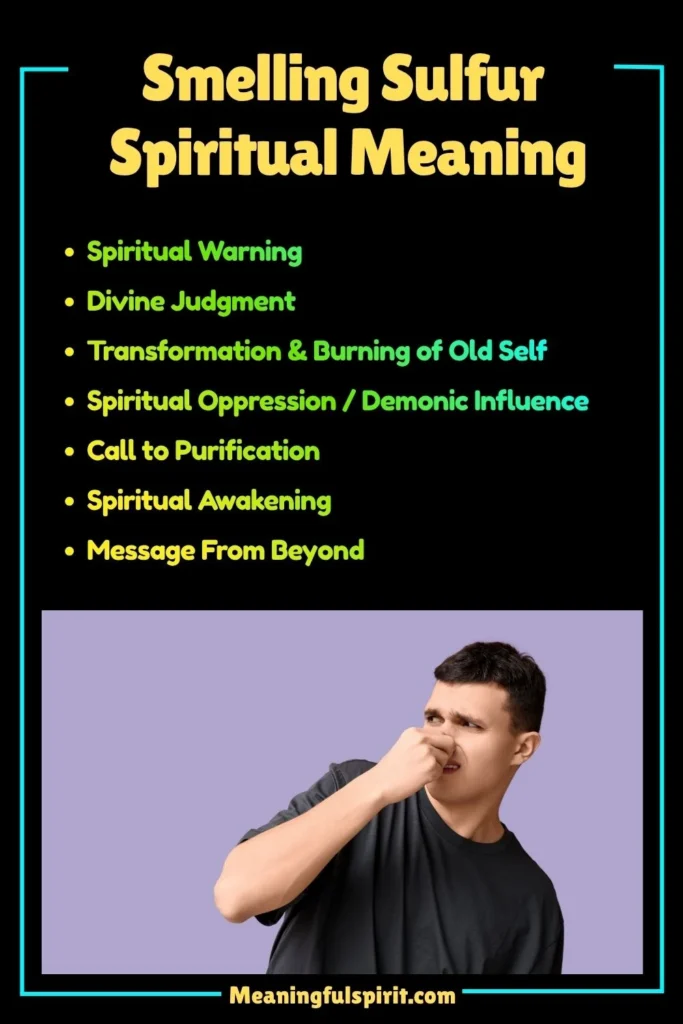
7 Spiritual Meanings of Smelling Sulfur
1. A Warning From the Spiritual Realm
The oldest and most consistent spiritual interpretation of smelling sulfur without a physical cause is that of a warning. Across Christian tradition, Islamic folklore, and various indigenous belief systems, a sudden unexplained sulfur smell signals that something spiritually significant, and often dangerous, is nearby. This is not metaphor. Practitioners of spiritual warfare and discernment have documented this experience for centuries, associating the scent with the presence of negative entities, demonic activity, or corrupted spiritual energy in a space.
Think of it like a smoke alarm. The alarm does not cause the fire. It signals that something requires your immediate attention. When you smell sulfur without explanation, many spiritual teachers interpret it as your spiritual senses alerting you to an unseen presence or an energetic imbalance in your environment. This meaning calls for prayer, cleansing rituals, and heightened awareness rather than panic.
Spiritually mature traditions, including Pentecostal Christianity and certain African Diaspora practices, treat this as a call to action. They view the smell as meaningful data, prompting discernment and protective spiritual work. The smell does not mean you are doomed. It means your awareness is being activated and your response matters.
This interpretation is backed by long spiritual lineage. In her book Prepare for War, Rebecca Brown documents accounts of this smell accompanying spiritual oppression in people undergoing deliverance ministry. Dismissing the experience out of hand ignores centuries of consistent testimony from spiritually serious people across vastly different cultures.
2. Divine Judgment and Accountability
Fire and brimstone are not just theological metaphors. They represent God’s active, decisive response to unrighteousness. The story of Sodom and Gomorrah in Genesis 19:24 describes God raining down brimstone and fire directly from heaven. This was the most complete act of divine judgment recorded in the Torah. The smell of sulfur, inseparable from that event, became the olfactory symbol of divine accountability.
When you smell sulfur in a spiritual context, certain traditions interpret it as a call to examine your own life. Are you living with integrity? Are there areas of deep moral compromise you have been avoiding? The smell may not mean you are under judgment. It may mean the divine is prompting you to judge yourself before an external reckoning becomes necessary.
This is a spiritually active meaning, not a passive one. In Psalm 11:6, the psalmist writes of God raining “fire and burning sulfur” on the wicked. The imagery is not just punishment. It is the purifying force of ultimate truth applied to a situation that can no longer be ignored. Smelling sulfur may be the universe’s way of saying that the time for self-examination is now.
The Book of Revelation amplifies this. Sulfur appears repeatedly in end-times imagery, most powerfully in Revelation 20:10, where the lake of burning sulfur serves as the final destination of unrepentant evil. The smell carries this biblical weight with it across centuries. Whether your tradition is Christian or not, the association between sulfur and moral accountability is deeply embedded in Western spiritual consciousness.
3. Transformation and the Burning Away of the Old Self
Not every spiritual tradition reads sulfur as dark. In alchemy, sulfur held a completely different role. Medieval alchemists, including the 16th-century Swiss physician and occultist Paracelsus, classified sulfur as one of the three fundamental spiritual principles alongside mercury and salt. Sulfur represented the soul, fire, and the capacity for change. Mercury represented the spirit. Salt represented the body. Together, they formed the complete human being.
The alchemical understanding is that sulfur burns away impurity. Like fire refining metal, the sulfurous process in alchemy was not about destruction for its own sake. It was about the necessary burning away of what is false, so that what is true and pure can emerge. Smelling sulfur in a spiritual context can signal that you are in the middle of this exact process, a profound shedding of old identities, beliefs, or patterns that no longer serve your soul.
This is confirmed by the reports of many people who smell sulfur during significant life transitions: divorces, career collapses, spiritual crises, or the deaths of important relationships. These transitions hurt. They feel like burning. They are meant to. Alchemists understood this and called it calcinatio, the stage of transformation through fire. The smell may be a confirmation that your transformation is real, recognized, and necessary.
The spiritual invitation here is to stop resisting the burning. What you are losing is not your true self. The fire is targeting exactly what was never truly you to begin with. The sulfur smell in this context is not a threat. It is a signal that the alchemical work of your soul is actively underway.
4. The Presence of Spiritual Oppression or Demonic Influence
Some spiritual experiences leave little room for symbolic interpretation. Many people who report smelling sulfur during moments of psychological torment, night terrors, or acute spiritual attack describe the smell as visceral, overwhelming, and immediately threatening. Christian tradition, particularly within charismatic and deliverance contexts, directly associates this experience with demonic presence.
This is rooted in specific biblical theology. The Book of Revelation uses sulfur repeatedly to describe the domain of Satan, the beast, and the false prophet. Revelation 9:17-18 describes horses with heads of lions, breathing fire, smoke, and sulfur. This is not decorative language. It reflects a spiritual reality that certain forces of darkness carry a sulfuric signature. Their presence can be discerned through scent, among other ways.
Pastor and spiritual warfare teacher John Ramirez, who describes his background in Santeria before converting to Christianity, has spoken extensively about this. He states that sulfur is one of the clearest olfactory signs of demonic activity and that trained intercessors recognize it immediately. His testimony aligns with accounts from missionaries, exorcists, and prayer ministers across multiple Christian traditions.
If you experience the smell alongside feelings of dread, oppression, disturbing thoughts, or disrupted sleep, this spiritual meaning demands attention. It calls for prayer, anointing of your home, spiritual authority, and community support. This is not the time for detached philosophical pondering. This is the time for active, grounded spiritual response.
5. A Call to Purification and Spiritual Cleansing
The ancient world used sulfur as a disinfectant and fumigant long before science explained why it worked. Greeks burned it to purify spaces. Egyptians used it in mummification rituals to prepare the body for spiritual transition. Indigenous North American traditions incorporated sulfur-rich hot springs into healing ceremonies, treating the water as a bridge between the physical world and the spirit world.
This pattern is not coincidental. Cultures that had no contact with each other independently arrived at the same conclusion: sulfur purifies. When the spiritual meaning of smelling sulfur points to purification, it is often a signal that your life, your space, your relationships, or your inner world has accumulated spiritual residue that needs to be cleared.
Think of accumulated bitterness, unresolved grief, long-standing resentments, or spaces where negative events occurred repeatedly. These things do not just exist emotionally. Many spiritual traditions teach that negative energy leaves a kind of residue in both people and places. The smell of sulfur, in this reading, is the spiritual immune system identifying something that needs to be addressed.
The practical response to this meaning includes energetic clearing of your space, personal confession or moral inventory, ending toxic relationships, or a period of fasting and focused prayer. The smell is not an accusation. It is an invitation to housekeeping at the soul level, a prompt that the environment you are living in, internally or externally, is ready for deep cleansing.
6. Spiritual Awakening and Heightened Sensitivity
Some people begin smelling sulfur only after their spiritual sensitivity increases. This is particularly common during periods of fasting, intense prayer, meditation retreats, or the early stages of spiritual awakening. In these cases, the smell is not attached to a threatening presence. It seems to arise as spiritual perception opens, as though the person is beginning to smell a layer of reality that was always there but previously undetected.
Many spiritual traditions teach that the physical senses have spiritual counterparts. The ability to smell spiritually significant scents, whether floral aromas indicating angelic presence, incense without a source, or sulfur, falls under what Christians call the discerning of spirits. In New Age and metaphysical frameworks, it is described as clairalience, clear spiritual smelling. As a person’s spiritual awareness expands, they may begin to encounter smells that others around them do not notice.
The sulfur smell in this awakening context is often accompanied by other signs: increased synchronicities, vivid or prophetic dreams, a deep sense of being watched over or guided, and strong intuitive hits that later prove accurate. If this matches your experience, the sulfur smell may be less of a warning and more of a confirmation that your spiritual senses are coming online.
The appropriate response is not fear. It is discernment paired with grounding. Develop your spiritual practice. Seek out a teacher or community that understands spiritual gifts. Keep a journal of your experiences. The sulfur smell in this context is a marker of growth, not danger.
7. A Message From Beyond: Spiritual Communication
Across multiple traditions, unexpected and unexplained smells are treated as a form of communication from deceased loved ones, spirit guides, or angelic messengers. While floral scents like roses are most commonly associated with benevolent spiritual communication, sulfur also appears in this context, particularly in traditions that work with ancestral spirits or more complex spiritual entities.
The 19th-century spiritualist movement documented this extensively. Emma Hardinge Britten, one of the most prominent spiritualists of the era, recorded in Modern American Spiritualism (1870) that sulfurous odors were commonly reported during séances and spirit communications, particularly during manifestations of powerful or intense spiritual energies. The interpretation was not always negative. It was understood as a sign that a strong presence was making contact.
In indigenous traditions across several continents, the smell of sulfur near sacred volcanic sites or hot springs was read as the breath of powerful ancestral spirits or earth deities. It was treated with reverence. The smell said: something ancient, powerful, and aware is present with you right now.
If you experience sulfur during a time of grief, near significant dates connected to a deceased person, or while in prayer about a specific question, do not dismiss it. Sit with it. Pray through it. Ask what message may be trying to come through. The answer may not arrive immediately. Stay open.
The Biblical Meaning of Smelling Sulfur
The Bible has more to say about sulfur than most people realize. Brimstone, the biblical name for sulfur, appears 15 times in the King James Version. The Hebrew word gophriyth covers seven Old Testament references. The Greek theion accounts for seven more in the New Testament. This frequency alone tells you that sulfur was not a peripheral symbol. It was central to how the biblical writers communicated about divine power, judgment, and ultimate reality.
The most famous reference is Genesis 19:24: “Then the Lord rained upon Sodom and upon Gomorrah brimstone and fire from the Lord out of heaven.” This was not a geological coincidence dressed up in religious language. The text presents it as a direct act of divine judgment against cities that had become saturated with corruption. Sulfur fell from heaven. That image locked the scent of sulfur permanently to the idea of sacred accountability in the biblical imagination.
Isaiah uses sulfur as a vivid portrait of divine wrath and coming destruction. Isaiah 30:33 describes a place prepared for the wicked: “the breath of the Lord, like a stream of sulfur, doth kindle it.” Psalm 11:6 echoes the same theme. These texts are not poetry for its own sake. They are theological statements about the nature of unchecked sin and God’s response to it.
The Book of Revelation intensifies this thread. Sulfur appears repeatedly in its end-times visions. In Revelation 9:17-18, John describes horses whose riders unleash plague through fire, smoke, and sulfur. In Revelation 20:10, the devil himself is thrown into the lake of fire and sulfur. In Revelation 21:8, this lake is described as the “second death”, reserved for cowards, liars, and the unrepentant. Sulfur in Revelation is the smell of ultimate consequence.
Yet the Bible also hints at a more complex picture. Sulfur was real. It sat on the shores of the Dead Sea. It fell from volcanoes. It was woven into the very fabric of the physical world God created. The same element associated with judgment was also used historically for disinfection and healing, connecting it, however quietly, to themes of restoration and correction rather than only annihilation.
Sulfur’s Spiritual Meaning Across Cultures and Religions
The spiritual significance of sulfur did not begin or end with the Bible. Cultures across the globe developed their own profound relationships with this element, often arriving at strikingly similar conclusions despite having no contact with each other.
In ancient Egypt, sulfur was used in mummification. Priests treated it as a substance that could purify the physical body in preparation for the spiritual journey of the afterlife. It was a bridge element: something that helped the human cross from one state of existence to another. This makes the Egyptian use of sulfur less about fear and more about sacred transition.
Ancient Greek civilization burned sulfur as a fumigant to purify homes, temples, and spaces where the dead had passed. The poet Homer references this practice. Greek physicians like Hippocrates used sulfur medicinally. The connection between sulfur’s purifying properties and its spiritual significance was taken for granted. A space cleansed with sulfur was seen as spiritually prepared for sacred activity.
In Islamic tradition, fire and sulfur carry strong associations with divine punishment and the reality of hellfire (Jahannam). The Quran, like the Bible, uses fire and burning as the primary imagery for the consequences of unbelief and moral corruption. Sulfur intensifies this imagery, giving it a sensory specificity that fire alone cannot.
Indigenous North American cultures around geothermal areas, particularly those in the American Southwest and Pacific Northwest, treated sulfur-rich hot springs as deeply sacred. These were not simply healing waters. They were thresholds, places where the barrier between the material world and the spirit world grew thin. Entering such waters was an act of spiritual as much as physical significance.
African spiritual traditions, including Ifa and various Vodou systems, work with complex spirit entities whose presence may be marked by strong, unexpected smells. Some practitioners describe sulfur-adjacent odors as signs of particular orishas or lwa making themselves known, particularly those associated with transformation, thresholds, and necessary disruption.
Smelling Sulfur in Alchemy and Esoteric Traditions
Among the most intellectually rich interpretations of sulfur comes from Western alchemy, the philosophical and proto-scientific tradition that flourished in Europe and the Islamic world from the Middle Ages through the Renaissance. Alchemists were not simply trying to turn lead into gold. They were working on the transformation of the human soul, and sulfur was at the very center of their symbolic system.
The Tria Prima, or three primal principles of alchemy as formulated by Paracelsus, consisted of sulfur, mercury, and salt. Sulfur represented the soul and its fiery, combustible nature. It was the principle of transformation: the force that burns through impurity to reveal the essential truth beneath. Mercury represented the volatile spirit. Salt represented the stable, material body. Without sulfur, there could be no transformation.
According to scholar Mark Haeffner in The Dictionary of Alchemy (2004), medieval alchemical texts consistently treated sulfur as a purifying agent capable of transforming base materials into their highest form. This was read both literally and metaphorically. The alchemical process was always simultaneously an inner process. When sulfur appeared in the alchemist’s laboratory, it was also appearing in the alchemist’s soul.
The smell of sulfur in alchemical work was considered a sign that the transformative process was actively happening. It was not feared. It was welcomed as confirmation of spiritual and material transmutation in progress. If you are working through a period of intense inner change, the smell of sulfur may carry exactly this meaning for you: you are in your own alchemical crucible, and the transformation is working.
The 19th-century spiritualist movement added another dimension. Practitioners documented sulfurous smells during séances, often interpreting them as confirmation that a powerful spirit presence had arrived. This was treated as neutral-to-positive data: a strong energy manifesting in a detectable, physical way. The smell was not evil in this context. It was evidence of spiritual reality breaking through the material veil.
Smelling Sulfur in Dreams: What It Spiritually Means
Dreams involving sulfur, whether you smell it, see it burning, or encounter it in some other form, carry their own specific spiritual weight. Dream interpretation across religious and psychological traditions agrees on one thing: sensory experiences in dreams are among the most significant and personally relevant dream content you can encounter.
If you smell sulfur in a dream, the most consistent spiritual interpretation is that your unconscious mind, your soul, or the divine is signaling a need for deep examination and inner cleansing. The dream is using the sulfur scent as a flag. Something in your life, possibly something you have been avoiding, requires confrontation and resolution.
Carl Jung, who drew heavily from alchemical symbolism in developing his psychology, would likely have read a sulfur dream as an encounter with the shadow, the repository of denied, suppressed, or disowned aspects of the self. Sulfur, in his framework, represents the fiery, transformative energy needed to integrate the shadow. The dream is not a condemnation. It is an invitation to do the deeper work.
From a biblical standpoint, dreaming of fire and brimstone has historically been read as a prophetic prompt, a call to repentance, realignment, or urgent action before circumstances force it. The dream operates as a grace: a warning given while there is still time to respond. Pay close attention to the emotional tone of the dream. Were you afraid? Relieved? Awestruck? Your emotional response is often the most important interpretive key.
If sulfur appears in a dream alongside water (as in volcanic hot springs), the combination may signal both purification and healing. If it appears with fire consuming an old structure, the dream likely points to the necessary destruction of something outdated in your life. If the smell appears in a dream about a deceased person, it may reflect unresolved grief, a lingering spiritual connection, or a message that needs to be received and processed.
What to Do When You Smell Sulfur With No Physical Source
Spiritual experience always calls for a practical response. If you smell sulfur with no identifiable physical cause, the first step is ruling out the material explanation. Check for gas leaks. Check for old pipes, nearby volcanic or geothermal activity, or environmental sources. This is not a lack of faith. It is wisdom. A gas leak is a real danger. Address it first.
Once you have ruled out physical causes, sit with the experience rather than rushing past it. Note exactly when it happened. Were you praying? Sleeping? Going through a difficult decision? Was it in a specific room? Was someone nearby? These details matter for discernment.
Pray through it. Ask clearly, whether you frame this as prayer to God, meditation, or inner listening, what this experience is communicating. Write down what comes to you. Do not force an answer. Many spiritual messages arrive gradually, confirmed by circumstances that unfold in the days following the experience.
If you felt fear, oppression, or threat alongside the smell, respond with spiritual authority. Clean your space, physically and spiritually. Invite trusted spiritual community into the situation. Seek guidance from a pastor, spiritual director, or someone experienced in spiritual discernment. You do not have to navigate strong spiritual experiences alone.
Summary Table: Spiritual Meaning of Smelling Sulfur at a Glance
| Aspect | Key Meaning |
|---|---|
| General spiritual meaning | Warning, transformation, judgment, purification, or spiritual presence |
| Biblical meaning (brimstone) | Divine judgment, accountability, destruction of the wicked, end-times imagery |
| Old Testament reference | Genesis 19:24, Sodom and Gomorrah; Psalm 11:6; Isaiah 30:33 |
| New Testament reference | Revelation 9:17-18; Revelation 20:10; Revelation 21:8 |
| Alchemical meaning | Soul principle; transformation through fire; purification of base elements |
| Ancient Egyptian meaning | Purification for the afterlife; sacred transition between states of being |
| Ancient Greek meaning | Fumigation; spiritual cleansing of sacred spaces and homes |
| Indigenous traditions | Bridge between physical and spiritual worlds; sacred threshold at hot springs |
| Demonic presence | Strong negative entities; spiritual oppression; call for warfare prayer |
| Spiritual awakening | Heightened spiritual sensitivity; clairalience; discerning of spirits developing |
| Dream meaning | Shadow work, need for inner cleansing, confrontation with avoided truth |
| Olfactory spiritual gift | Clairalience; direct perception of spiritual reality through the sense of smell |
| Practical response | Rule out physical causes, pray, journal, seek spiritual community |
A Final Note
The spiritual meaning of smelling sulfur is not a single answer. It is a conversation between the scent, your context, your spiritual tradition, and the condition of your inner life. What it means for you depends on when you smelled it, how it felt, and what was happening in your life at that moment.
What the long sweep of spiritual history makes clear is this: do not dismiss it. Cultures that lived closer to fire, earth, and the raw presence of nature did not mistake sulfur for nothing. They treated it as a sign carrying real spiritual weight. Their instinct was correct.
If the smell came as a warning, respond with discernment and spiritual protection. If it came as a call to transformation, lean into the fire rather than away from it. If it came as a signal of purification, take the soul-level housekeeping seriously. If it came during awakening, develop your spiritual gifts with humility and grounded community.
Consider keeping a spiritual journal where you document these kinds of experiences alongside dates, circumstances, and what felt significant. Patterns often emerge over weeks or months that could not be seen in a single moment. That documentation may prove to be an important map of your own spiritual journey.
Consider also speaking with a pastor, spiritual director, or experienced mentor in your tradition. Spiritual discernment is rarely best done in isolation. The experiences that seem most unusual are often the ones that most need an experienced, grounded voice to help interpret.
The smell of sulfur is ancient. It has carried meaning since the first person stood near a volcano and felt both terrified and awestruck. That sense, that something immense and real is present, is still the right starting point. Pay attention. Ask questions. Stay spiritually alert. The universe rarely sends a scent like that without a reason.