
When the Sky Sends Ice, the Universe Is Speaking
Have you ever stood beneath a hailstorm and felt something deeper than fear? Have you wondered why the sky would send down frozen stones instead of soft, nurturing rain? You are not alone in asking that question. Across thousands of years and dozens of civilizations, hail has captured human imagination in ways that no other weather phenomenon quite matches.
Hail is violent. It is sudden. It arrives without apology and leaves behind a trail of broken flowers, dented cars, and shattered silence. Yet, in the world of spiritual symbolism, very few natural events carry as much concentrated meaning as a hailstorm. The spiritual meaning of hail stretches from divine punishment and cosmic warning to purification, transformation, and soul-level awakening.
Most people stop at the surface. They check the weather report, wait for the storm to pass, and move on. But if you have been drawn to dig deeper, your instincts are pointing you somewhere significant. Spiritual symbolism teaches us that nature speaks in a language older than any human tongue. Hail is one of its most emphatic sentences.
Whether you witnessed a hailstorm recently, dreamed about hail, or simply feel a magnetic pull toward its meaning, this deep-dive into hail spiritual meaning and symbolism will give you the full picture. You will walk away with a profound new understanding of what the universe may be trying to say to you.
Key Takeaways
- Hail spiritually represents divine intervention, cosmic warning, and the forceful clearing of old, stagnant energies from your life path.
- Across biblical texts, hail is one of the most powerful symbols of God’s judgment, justice, and sovereign authority over human affairs.
- In Native American, Norse, and Eastern traditions, hail symbolizes transformation through destruction, seasonal cycles, and the unpredictable power of spirit forces.
- Dreaming about hail often signals suppressed emotional conflict, incoming life challenges, or an urgent call from your subconscious to change course.
- The spiritual message of hail is not always one of punishment. For many seekers, it represents purification, the stripping away of illusions, and the fierce love of a universe that refuses to let you stay small.
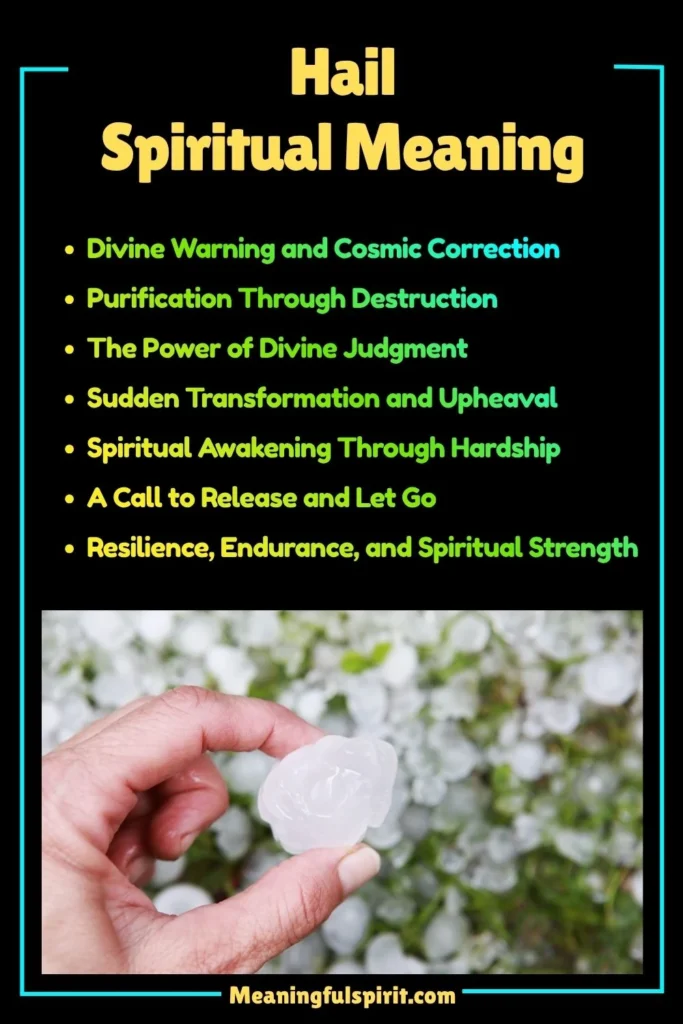
What Is Hail and Why Does It Carry Spiritual Weight?
Before stepping into symbolism, it helps to understand what hail actually is. Hail forms inside thunderstorms when updrafts carry water droplets to freezing altitudes. Those droplets freeze, accumulate layers of ice, and eventually fall to earth as hard, icy pellets. They can range from the size of a pea to the size of a grapefruit. A serious hailstorm can destroy crops in minutes, shatter greenhouse glass, and flatten entire fields overnight.
That physical reality is the first reason hail holds such spiritual gravity. Nature rarely delivers a more dramatic, targeted, and unignorable message. Unlike rain, which is gentle and expected, or thunder, which booms from a distance, hail strikes directly. It hits the ground, the roof, the skin. It demands your immediate attention.
Ancient peoples understood this instinctively. When hail fell, it was not random. It was a signal. Priests, shamans, oracles, and prophets across every major civilization treated hailstorms as divine communications. They asked: What have we done? What must we change? What is the sky trying to correct? Those questions form the spiritual backbone of everything hail represents.
Hail also carries the dual nature of water and ice. Water is universally associated with emotion, spirit, and life. Ice represents the hardened, solidified, and immovable. When water becomes hail, something fluid and life-giving has been transformed into something piercing and destructive. That transformation is spiritually rich. It speaks to moments in life when tender truths become hard lessons.
What Does Seeing Hail Symbolize or Represent?
Seeing hail, whether in waking life or in a vision, is rarely something you can brush aside. The symbolic meaning of seeing hail depends heavily on context, but several core themes run through nearly every interpretation.
Seeing hail fall is most commonly interpreted as a sign that something in your life is about to be forcefully disrupted. This is not always negative. Sometimes the most loving thing the universe can do is break apart what was never truly serving you. The hail strips away the comfortable but hollow, the familiar but toxic, the safe but limiting.
When you watch hail from inside, protected and observing, the spiritual message shifts. You are being shown a storm without being consumed by it. This often symbolizes spiritual awareness and detachment. You are growing wise enough to witness difficulty without being destroyed by it. The spiritual realm may be saying: you have earned a new level of perspective.
If you see large hailstones, the message is amplified. Size in spiritual symbolism always relates to magnitude of impact. Large hail suggests that whatever transformation or reckoning is coming, it will be significant and unmistakable. Small hailstones, on the other hand, may point to minor disruptions or gentle warnings to course-correct before things escalate.
Seeing hail destroy crops or gardens carries specific symbolic weight tied to harvest and labor. In spiritual terms, crops represent the fruits of your efforts. When hail destroys them, it may be signaling that your current efforts are being redirected. What you worked so hard to build may not be aligned with your soul’s true direction.
7 Spiritual Meanings of Hail
1. Divine Warning and Cosmic Correction
The most ancient and widespread spiritual meaning of hail is that of a divine warning. Across virtually every civilization that kept spiritual records, hail was understood as a message from a higher power. It was not interpreted as random. It was interpreted as intentional, targeted, and corrective.
The Hebrew Bible treats hail as one of God’s most decisive tools of communication. In Exodus, hail was the seventh plague sent upon Egypt, and it is described with extraordinary detail. It was not mere weather. It was judgment delivered with precision. This establishes a powerful spiritual archetype: hail as cosmic correction for choices that have drifted from truth, justice, or divine alignment.
What makes this meaning deeply personal is that it asks you to examine your own life with honesty. When a hailstorm arrives in your experience, whether literally or symbolically, the spiritual invitation is to stop and ask: Where am I cutting corners? Where am I ignoring warning signs? What truth am I refusing to face? The hail does not arrive to punish you arbitrarily. It arrives because something needs to change.
This meaning is actually a form of cosmic love and care. A universe that does not bother to warn you is indifferent. A universe that sends hail is one that still believes in your capacity to transform and correct course. The warning is the gift.
2. Purification Through Destruction
One of the most profound spiritual meanings of hail is purification through destruction. This may sound paradoxical at first. How can something that breaks and batters also cleanse? The answer lies in the deeper logic of spiritual growth.
Purification rarely feels gentle. The ancient alchemists understood this. To purify gold, you must first melt it down completely. To purify a wound, you must first open it and expose it to air. Hail operates on the same spiritual principle. It arrives with force, and in its wake, what was rotten, weak, or false cannot survive.
Farmers throughout history observed that fields struck by hail, while devastated in the short term, often produced richer soil in subsequent seasons. The violent impact of hailstones breaks up compacted earth, aerates the soil, and forces a new beginning. Spiritually, your life operates the same way. Sometimes you need something fierce to break through your own compacted patterns, defenses, and cycles.
When you experience a period of intense disruption that feels like hail, you may be in a purification cycle. Old relationships, outdated belief systems, and self-limiting habits are being cleared. The clearing hurts. But what grows in the aftermath of honest purification is almost always stronger, truer, and more aligned with your authentic self.
3. The Power of Divine Judgment
Hail as a symbol of divine judgment is deeply embedded in the world’s major spiritual traditions. This is not a gentle judgment of quiet discernment. It is the kind of judgment that arrives when patience has been exhausted and accountability must be honored.
In the book of Revelation, hail appears again as one of the final signs of divine reckoning. Revelation 16:21 describes hailstones “about the weight of a talent” falling upon the unrighteous. This imagery is not chosen casually. The weight and force of hail become metaphors for the weight and force of truth when it can no longer be ignored.
Spiritually, divine judgment through hail is not about cruelty. It is about the restoration of balance. In every spiritual system, there is a principle of cosmic law: what is sown will be reaped, karma will cycle back, actions ripple outward and return. Hail symbolizes the moment when that cycle reaches its conclusion. The account is being settled.
For you personally, this meaning invites deep reflection on integrity and accountability. Are there areas where you have been dishonest, either with others or with yourself? Are there actions from your past whose consequences you have been avoiding? The spiritual message of hail as divine judgment is not a threat. It is a call to make things right before the storm arrives.
4. Sudden Transformation and Upheaval
Hail symbolizes sudden transformation in a way that few other natural symbols can match. It arrives without extended warning. It changes the landscape in minutes. And it leaves you in a world that looks noticeably different from the one you were standing in before it began.
This is a deeply meaningful spiritual archetype for those going through rapid, unexpected life changes. Job loss, sudden illness, the end of a relationship, a move to a new city — these are all hailstorm moments. They are not gradual. They do not give you time to prepare fully. They simply arrive and rearrange everything.
The spiritual wisdom embedded in this symbolism is that not all transformation can be gentle. Some soul growth only happens when the old structure collapses fast enough that you cannot rebuild it prematurely. Hail is the symbol of that necessary speed. When the universe decides a transformation is overdue, it sometimes uses hail rather than slow rain to make its point.
If your life is currently in a state of sudden upheaval, hail symbolism offers you this: you are not being destroyed. You are being transformed. The speed of the change is proportional to the depth of the new life waiting on the other side. Trust the storm. Do not fight it. The transformation it brings will eventually reveal itself as exactly what you needed.
5. Spiritual Awakening Through Hardship
Not all spiritual awakenings arrive peacefully. Some come as earthquakes. Others come as hailstorms. This is one of the most personally relevant spiritual meanings for anyone walking a conscious spiritual path.
The spiritual meaning of hail in this context is the awakening that comes not from meditation or quiet insight but from being hit hard by life. Many of the most spiritually evolved people on earth will tell you that their deepest awakening came during their most brutal season. Loss, grief, failure, and humiliation can function as hailstorms of the soul. They strip away every false comfort, every performance, every pretense, until only your truest self remains.
Ancient shamanic traditions across multiple continents recognized this explicitly. The shaman’s initiation often involved a period of extreme suffering, illness, or trauma that they called a “death and rebirth.” The individual had to survive their own inner hailstorm before they could serve others as a healer. This is the archetype of the wounded healer, and hail sits at the center of it.
If you are walking through hardship right now, hail’s spiritual meaning offers you a reframe. You are not being abandoned. You are being initiated. The suffering is not random. It is shaping you into a version of yourself that could not have existed without this storm. That is not a platitude. It is the spiritual logic of every meaningful transformation throughout human history.
6. A Call to Release and Let Go
Hail spiritually represents the act of release. When hailstones fall, they do not float or linger. They strike, they make their mark, and they melt. In that complete arc from frozen stone to water, there is a powerful spiritual message about attachment and release.
Much of human suffering is rooted in holding on past the natural expiration of things. You hold onto relationships that have completed their purpose. You cling to identities that no longer reflect who you truly are. You grip tightly to outcomes, plans, and timelines that the universe has already begun redirecting. Hail is the symbol of the forced releasethat comes when voluntary release has been avoided too long.
There is also something spiritually significant about how hail melts. What seemed so hard, so solid, so unyielding turns back into water. What pierced you eventually softens and disappears. This is a message about the impermanence of even your most painful seasons. The hardness does not last. The stone becomes water again. And water, as every spiritual tradition knows, is life.
When hail appears as a symbol in your life, ask yourself honestly: What am I holding onto that I have already been quietly asked to release? The universe rarely leads with a hailstorm. Hail usually arrives after gentler signals have been ignored. The call to release comes first as a whisper, then as rain, then as hail. Listen earlier next time.
7. Resilience, Endurance, and Spiritual Strength
The final and perhaps most empowering spiritual meaning of hail is the gift it leaves behind for those who endure it. Hail does not kill everyone it touches. Most of the time, it passes. The sun returns. And those who stood through the storm are not the same people they were before it began.
Resilience is born in storms. This is not merely a motivational phrase. It is a spiritual truth encoded into every culture that has ever faced hail. The Norse peoples who endured brutal northern winters, the desert tribes who witnessed rare but devastating hailstorms in arid lands, the farmers who replanted after total crop destruction — all of these people were shaped by their encounters with hail into people of extraordinary endurance and spiritual depth.
Hail tests what you are made of. It reveals the places where your foundation is solid and the places where it is not. That revelation, as painful as it is, is an act of spiritual generosity. You are not meant to build your life on a shaky foundation. The hail that exposes weakness is doing you a favor, even when it does not feel like one.
When you endure your hailstorm, whether external or internal, you emerge carrying a kind of wisdom that cannot be taught in calm conditions. You know something about yourself that you could not have known any other way. That knowing is sacred. Hail gives it to you as its final, most lasting gift.
Hail Symbolism Across Cultures and Religions
The spiritual symbolism of hail appears across a remarkably wide range of human cultures and religious traditions. Each culture brings its own lens, yet the core themes of power, judgment, transformation, and communication from the divine appear again and again.
In ancient Mesopotamia, hail was associated with the wrath of storm gods like Adad and Enlil. These gods were not benevolent figures who brought gentle rain. They were forces of cosmic authority. When Adad sent hail, it meant that the social or moral order had been violated. Communities would perform rituals of atonement and offer sacrifices to restore balance. Hail, in this context, was not random suffering. It was feedback from the divine order.
Aztec spirituality held a fascinating dual view of hail. On one hand, Tlaloc, the rain god, could send hail as a form of punishment or displeasure. On the other hand, certain hailstorms during planting seasons were interpreted as blessings from the spirit world, signs that the earth was being energetically charged for a rich harvest. This dual nature is important because it prevents a purely negative reading of hail symbolism.
In Hindu cosmology, hail relates to Indra, the god of thunder and storms. Indra’s hailstorms were understood as both destructive and cleansing. When Indra sent hail, he was not simply expressing anger. He was fulfilling his role as the maintainer of cosmic order (Rta). The storms were acts of sacred maintenance, ensuring that the universe continued to function according to divine law.
Celtic traditions associated hail with transformation and the threshold between seasons. The Celts were acutely sensitive to seasonal transitions, and hail, appearing unexpectedly in spring or early summer, signaled that the boundary between worlds was thin. It was a liminal weather event, associated with spirits, ancestors, and the breaking of ordinary time.
In Chinese spiritual thought, hail was seen as an imbalance between Yin and Yang energies. Unusually severe hailstorms were interpreted as signs that the emperor had fallen out of harmony with the Mandate of Heaven, the divine authority that legitimized his rule. Hail was not just atmospheric. It was political and spiritual commentary from the cosmos itself.
Hail Symbolism in World Mythologies
Mythology gives hail its most vivid and dramatic expressions. The mythological symbolism of hail is consistently tied to powerful divine figures, cosmic battles, and the fierce forces that govern the universe.
In Norse mythology, Thor is the thunder god and a wielder of storms. While Thor is most famous for his lightning and thunder, hail falls under the broader domain of storm forces in Norse cosmology. Hailstorms were sometimes described in Norse sagas as the breath of frost giants, the Jotnar, who represented chaos and the untamed forces of nature. A hailstorm was therefore a cosmic conflict made visible, the clash between the ordered world of gods and the raw chaos of giants.
Greek mythology connects hail to Zeus, the king of the gods. Zeus used storms as instruments of divine will, and hail specifically appeared in myths as a sign of extreme divine displeasure. In the myth of the flooding of the world, early versions include hail as part of the catastrophic weather sent to cleanse the earth of moral corruption. The Greeks also associated hail with Boreas, the god of the north wind, whose breath was cold and icy. Boreas was a fierce and uncontrollable force, and hail was his fingerprint on the landscape.
In Slavic mythology, hail was personified in figures like Poludnitsa and the various storm spirits known as Oblachniki, cloud spirits who were thought to ride on storm clouds and carry hail with them. These spirits were not purely evil. They were agents of cosmic balance, ensuring that the earth received the full spectrum of weather, not just the pleasant variety. Rituals to appease these spirits before harvest time were common throughout Slavic agricultural communities.
Mesoamerican mythology is particularly rich in hail symbolism. Among the Maya, hail was associated with Chahk, the storm deity who controlled all aspects of rain, lightning, and severe weather. Chahk could be both a provider and a destroyer, and hail was one of his most dramatic expressions. Hailstorms during critical growing seasons were interpreted as Chahk demanding acknowledgment, ritual attention, or a course correction in community behavior.
In Japanese Shinto mythology, severe weather events including hail were connected to the kami (spirits or gods) of storms, particularly Susanoo, the storm god who was also associated with the sea. Susanoo was a complex figure, capable of both devastating destruction and heroic, protective action. Hail under his influence represented the unpredictable nature of power and the spiritual reality that divine forces operate beyond simple categories of good and evil.
Types of Hail and Their Spiritual Meanings
Not all hail is spiritually equal. The size, timing, duration, and impact of a hailstorm all carry distinct symbolic weight in spiritual interpretation.
Small hailstones, sometimes called graupel or soft hail, carry a gentler spiritual message. They represent early warnings and minor course corrections. Think of them as the universe using a soft knock on the door before resorting to something louder. If you experience small hail, the invitation is to check in with yourself now, while the stakes are low. What needs adjusting in your life before the warning escalates?
Large hailstones are a different matter entirely. Golf ball-sized or larger hail carries a heightened spiritual urgency. When the message needs to be unmistakable, the universe uses large hail. This kind of hailstorm symbolizes a major life pivot point, a moment when the divine is insisting on your full attention. Ignoring large hail, spiritually speaking, often leads to even louder disruptions down the path.
A hailstorm at night carries particular mystical significance. Night in spiritual symbolism represents the subconscious, the hidden, and the deeply personal interior world. Hail falling in darkness may signal that the disruption or transformation you are experiencing is rooted in subconscious patterns and shadow material. What you have hidden from yourself is now demanding acknowledgment, even in the dark, even where no one else can see.
Hail followed by immediate sunshine is one of the most spiritually uplifting weather combinations imaginable. This sequence represents the full arc of transformation and renewal. The storm came, it did its work, and now clarity and warmth are restored. If you witness this pattern, take it as a powerful spiritual affirmation. Whatever storm you are enduring in life will pass into sunlight. The contrast between the ice and the light makes the warmth feel all the more real.
A hailstorm that damages only one location while leaving nearby areas untouched was historically interpreted as targeted spiritual communication. Ancient peoples saw no coincidence in this. The specificity of hail’s impact was itself the message: this particular place, this particular person, this particular situation is the one the divine is addressing.
Biblical Meaning of Hail and Its Spiritual Significance
The Bible gives hail a more prominent role than almost any other scriptural tradition. Hail appears in at least nine distinct passages across the Old and New Testaments, and in nearly every case, it carries enormous spiritual weight.
The most dramatic biblical account of hail is in Exodus 9:13-35, describing the seventh plague of Egypt. God instructs Moses to announce the hailstorm before it arrives, which is itself spiritually significant. The warning is given. The opportunity to repent or take shelter is offered. Those Egyptians who feared the word of the Lord protected their servants and livestock. Those who did not were struck. This narrative introduces a crucial spiritual principle: hail as judgment always comes with a prior warning, and the response to that warning determines the outcome.
Joshua 10:11 records a dramatic battlefield scene where God sends enormous hailstones upon Israel’s enemies during the Battle of Gibeon. “More of them died from the hailstones than the Israelites killed with the sword.” Here, hail functions as direct divine military intervention, protecting God’s people through weather. The spiritual meaning is layered: God is sovereign over nature, and nature itself is an instrument of divine justice and protection.
Psalm 78:47-48 references the hail of Egypt as part of a larger meditation on God’s power and faithfulness. The psalmist recalls hail as evidence of God’s active involvement in human history. This frames hail not just as punishment but as testimony, a visible, undeniable record of divine engagement with the human story.
In the New Testament book of Revelation, hail appears in three distinct passages (8:7, 11:19, 16:21). The progression in Revelation is telling. The hail grows in intensity with each appearance. By Revelation 16:21, the hailstones weigh a talent (approximately 75 pounds each). This escalating imagery reflects a spiritual principle about consequences: when the earlier, gentler messages are ignored, the hail gets heavier.
Job 38:22-23 contains one of the most theologically rich hail references in scripture. God asks Job, “Have you entered the storehouses of the snow or seen the storehouses of the hail, which I reserve for times of trouble, for days of war and battle?” This passage establishes hail as deliberately stored and purposefully deployed by God. Hail is not weather. It is a weapon of divine strategy, held in reserve for appointed moments. That image is spiritually sobering and deeply powerful.
Dreaming About Hail: Spiritual and Psychological Meanings
Dreams about hail are among the more unsettling weather dreams you can experience. They tend to linger after waking, carrying an emotional residue that demands attention. Both spiritual and psychological traditions offer meaningful frameworks for understanding them.
Dreaming of hail falling on you is the most direct and intense version of this dream. Spiritually, it suggests that you feel targeted by forces beyond your control. You may be in a season of life where external pressures or consequences are arriving with force. Psychologically, this dream often surfaces during times of high stress, guilt, or anxiety, particularly when you feel that life is punishing you unfairly. The dream is your subconscious processing that weight and attempting to find meaning in it.
Watching hail from inside a safe shelter in a dream carries a very different spiritual tone. Here, you are protected. The storm is visible but cannot reach you. This dream often signals that you are developing spiritual resilience and inner protection. You are learning to observe chaos without being consumed by it. Many spiritual teachers would call this the beginning of genuine emotional and spiritual maturity.
Dreaming of hail that suddenly stops is a message of hope. Spiritually, this dream represents the end of a difficult season. The storm that has been battering your life is running out of energy. Relief is genuinely coming. Pay attention to what follows the hail in the dream. If sunshine appears, the message is powerfully affirmative. If clouds remain, more processing may still be ahead, but the worst is over.
Being caught in a hailstorm without shelter in a dream reflects vulnerability and unpreparedness. Spiritually, this signals that you may be moving into a phase of life or undertaking a challenge without adequate spiritual grounding or support. The dream is not a threat. It is a practical message: build your shelter before the storm arrives. Prepare spiritually, emotionally, and practically for the challenges currently moving toward your life.
Dreaming of hail during summer is particularly symbolic because hail and summer are seasonally contradictory. This dream reflects the spiritual theme of the unexpected. Something that should not be happening, something out of season and out of place, is arriving in your life. This could be an unexpected loss, a sudden opportunity, or an abrupt change that contradicts everything you anticipated. The contrast itself is the message: brace for the unexpected.
From a Jungian psychological perspective, hail in dreams often represents the shadow, the repressed, denied, or undeveloped aspects of the self that have accumulated enough psychic force to break through into consciousness. The hailstorm is the moment of shadow eruption. It is not comfortable, but it is necessary. Integrating your shadow, which is what the hailstorm is demanding, leads to greater wholeness and a more authentic life.
Hail as a Spiritual Sign: What Is the Universe Telling You?
When hail arrives in your life, whether as a weather event you witness, a symbol in a dream, or a recurring image in your meditation or prayer, it is worth taking the time to receive its message consciously.
The spiritual sign of hail in your waking life may be asking you to examine where you have been ignoring signals. Perhaps a relationship has been quietly unraveling and you have been pretending otherwise. Perhaps your health has been sending you whispers that you have been dismissing. Perhaps a career path that no longer fits your soul has been chafing against you, and you have been enduring rather than changing. Hail arrives when the quiet signals have not been enough.
Hail as a spiritual sign also speaks to timing. Hail comes during a specific, narrow window. It does not last for days. It arrives with intensity and then it passes. Spiritually, this is a message about urgency without permanence. The moment of reckoning or transformation is real and requires your attention, but it will not last forever. Act while the window is open. The hail is telling you that the time for action is now, not indefinitely.
Some spiritual traditions recommend specific practices when you encounter hail symbolically. Sitting in stillness after witnessing a hailstorm and asking in prayer or meditation: “What are you asking me to release?” is a powerful practice. Journaling after a hail dream, capturing every detail and then free-writing about where those themes appear in your current life, can unlock significant insight. Creating a ritual of release, whether writing something down and burning it, releasing an object into water, or speaking a declaration of surrender aloud, can help you align with the spiritual message hail is carrying.
Summary Table: Hail Spiritual Meaning at a Glance
| Aspect | Spiritual Meaning |
|---|---|
| Hail in general | Divine warning, cosmic correction, forced transformation |
| Small hailstones | Minor warning, early-stage course correction needed |
| Large hailstones | Major life pivot, urgent divine communication |
| Hail at night | Shadow work, subconscious disruption, hidden truths surfacing |
| Hail followed by sunshine | Transformation complete, renewal and clarity ahead |
| Localized hailstorm | Targeted spiritual message for a specific person or situation |
| Biblical hail | Divine judgment, justice, sovereign authority, accountability |
| Dreaming of hail | Emotional pressure, suppressed conflict, subconscious warning |
| Dreaming of shelter in hail | Spiritual protection, growing resilience, emotional maturity |
| Hail across cultures | Cosmic balance, divine displeasure, cleansing and renewal |
| Hail in Norse mythology | Chaos vs. order, primal forces, cosmic conflict |
| Hail in Aztec tradition | Divine duality, both punishment and energetic blessing |
| Hail symbolizing resilience | Endurance through hardship, earned spiritual strength |
| Hail as a call to release | Forced surrender of attachment, invitation to let go |
| Hail and purification | Destruction of what is false or weak, renewal of authentic self |
A Final Note
Hail is one of the most powerful spiritual symbols in the natural world. It speaks with force, with precision, and with purpose. Whether it arrives in your waking life, in your dreams, in scripture, or in the myths and legends passed down through human generations, hail is always saying something worth hearing.
The core spiritual message of hail is this: the universe is not indifferent to your life. It pays attention. When you drift away from truth, from integrity, from your authentic path, something in the cosmic order notices. And sometimes, it responds with hail. Not to destroy you but to redirect you. Not to punish you but to purify you. Not to break you but to break open what was keeping you small.
You are invited to approach hail with reverence rather than fear. Let it ask its hard questions. Let it do its stripping work. Let it crack open the soil of your life so that something richer and truer can grow. The hail always passes. What it leaves behind, for those who have the spiritual courage to receive it, is always more valuable than what it took away.
If hail has been showing up in your life or inner world, consider spending time in honest self-reflection and prayer. Sit with the questions it raises. Talk to a trusted spiritual mentor or counselor who can help you process the deeper themes you are navigating. And trust that the storm, however fierce, is serving your growth in ways you may not fully see until the sun returns.